Researched October 2026 · Pricing checked 29 Oct 2026
Datadog Review (2026): Bits AI, Code Security and Costs
What Datadog actually offers an engineer who reads code for a living: Bits Code, the MCP server, Code Security, and the bill that comes with them.
Summary
Datadog review summary: Datadog is the strongest single-vendor observability platform we checked, and its code-facing AI is now real. Bits Code opens pull requests from Datadog findings, the MCP server connects Claude Code and Codex CLI to live telemetry, and G2, Capterra and Gartner average 4.4 to 4.6 out of 5. The cost is a bill with five meters: $15 per host, $31 APM, $25 per committer and $500 per 500 AI credits. Bits Code is single-repo only. Score 7.4 out of 10.
Datadog is the strongest single-vendor observability stack we checked, and its code-facing AI (Bits Code, MCP server, Code Security) is now real. Public ratings average 4.4 to 4.6 out of 5 on G2, Capterra and Gartner. The catch is cost: infra starts at $15 per host per month, then APM, security and AI credits stack on top.
- Observability depth
- 9.2/10
- Code-facing AI
- 6.8/10
- Pricing clarity
- 4.6/10
- Setup speed
- 8.4/10
- Fit for small teams
- 5.5/10
- Traces, logs, deploys and errors correlate down to the code line in one UI
- MCP server connects Claude Code, Codex CLI and custom agents to live telemetry
- Agent install plus 1,000+ integrations gets dashboards running in minutes
- Per-host, per-signal and per-committer billing is hard to forecast past about 50 hosts
- Bits Code works on one repository at a time and bills through separate AI credits
- Support and sales friction shows up in public reviews, with Trustpilot at 1.7 out of 5
14-day trial, billing starts after the trial
How this review was built
- Plan paid
- No paid plan: documentation, pricing page and public review audit
- Version tested
- Datadog public pricing page and docs as of 29 October 2026, US1/US3/US5 price list
- Test period
- 2026-10-29 → 2026-10-29
This is a documentation and public-data audit, not a month of paid hands-on use, and we say so up front. On 29 October 2026 we read the live Datadog pricing page line by line, the Bits Code documentation, the MCP server and Code Security product pages, and captured screenshots of each at 1440 by 900. We then pulled ratings and review counts from G2, Capterra, Gartner Peer Insights, TrustRadius and Trustpilot, and read recurring complaints on r/sre and r/devops. We did not run Datadog against a production workload, so we make no latency or accuracy claims. Where a number is derived, such as cost per Bits Code fix, the arithmetic is shown.
Should you buy Datadog?
YES if you...
- Platform and SRE teams that want traces, logs, security and incident triage in one vendor
- Engineering orgs on GitHub, GitLab, Azure DevOps or Bitbucket that want observability findings turned into pull requests
- Teams already pointing Claude Code or Codex CLI at production data through MCP
NO if you...
- Teams under roughly 10 hosts that mainly need metrics and dashboards (Grafana is cheaper)
- Anyone who needs a self-hosted option, since Datadog is SaaS only
- Organizations that cannot tolerate usage-based bills without hard spending caps
What Datadog charges, from the live price list
Annual-billing list prices checked on 29 October 2026. On-demand rates are higher.
Infrastructure Pro
Annual billing, $18 on-demand
- 1,000+ integrations
- Container monitoring
- Agent-based auto-discovery
Infrastructure Enterprise
Annual billing, $27 on-demand
- Everything in Pro, at a higher per-host price
- Aimed at larger organizations
- Check the pricing page for the exact feature split
APM
Billed separately from infra; $36 on-demand with infra attached
- 150 GB ingested spans included per APM host
- Distributed tracing and service catalog
- APM Pro $35, Enterprise $40
Code Security (SAST)
Annual billing, $36 on-demand
- IDE and CI/CD scanning
- Suggested fixes in pull request comments
- SCA is also $25, IaC and secrets $15
AI Credits
About $1 per credit annually, $1.30 on-demand
- Bits Code fix: about 5 credits
- Bits Chat message: about 0.5 credits
- Bits Investigation: about 4 credits
ROI breakdown: A Bits Code fix costs about 5 credits. At $1 per credit that is roughly $5 per fix, or $6.50 on-demand at $1.30. The $500 block covers about 100 fixes a month, so it pays off only if your team merges more than a handful of them.
Hidden costs & gotchas
- No permanent free tier: 14-day trial, then billing starts
- Custom metrics and high-cardinality tags bill separately and cause most bill shock
- Retained spans cost $1.27 per million at 7 days and $1.70 at 15 days, on top of host fees
- Security products are priced per active Git committer, so headcount drives the bill
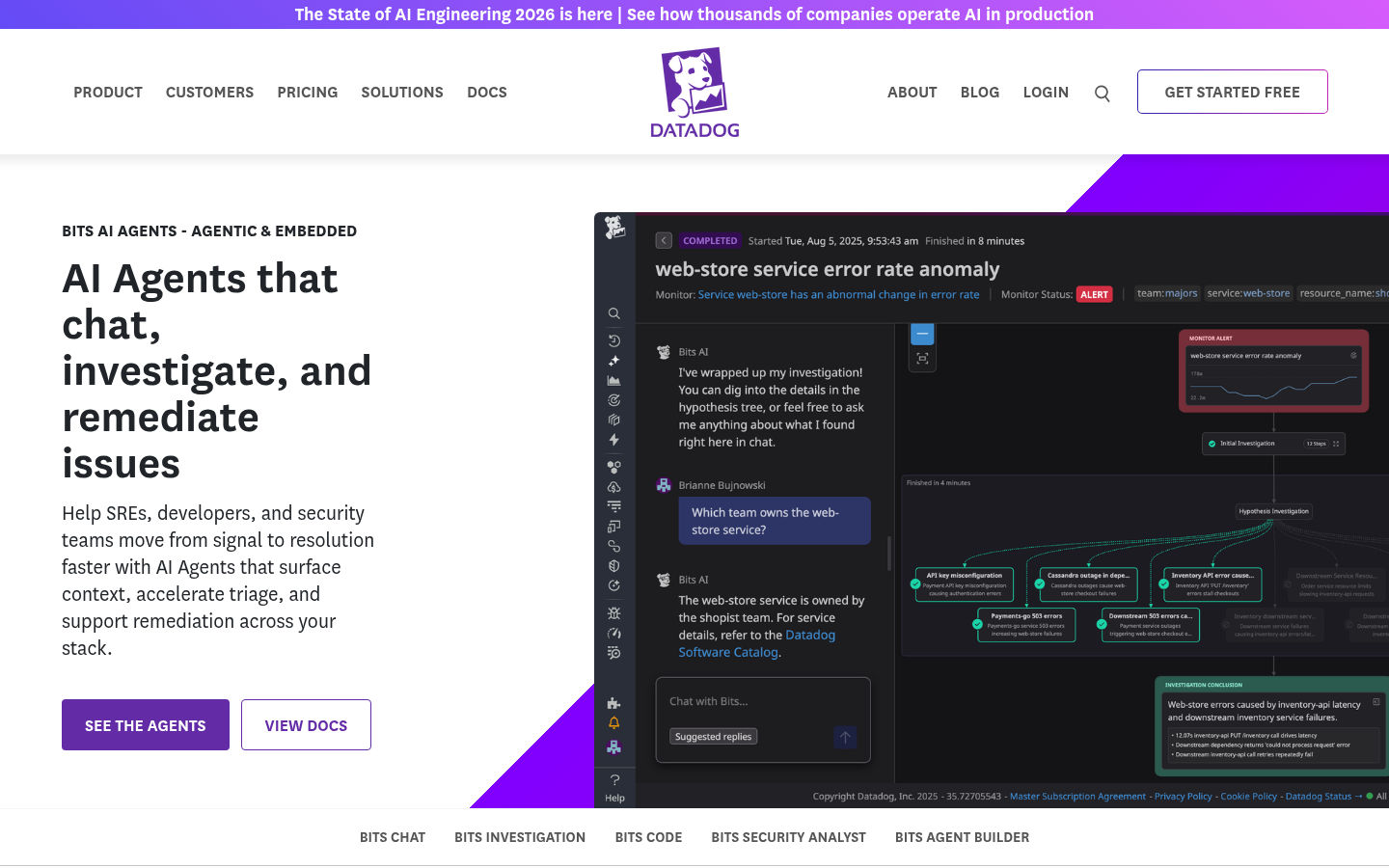
Bits AI agents investigate alerts in plain language
The Bits AI page shows an investigation of a web-store error rate anomaly: the agent builds a hypothesis tree, ties the alert to an inventory API latency problem and answers follow-up questions in chat, such as which team owns the service.
- Investigation finished in 4 minutes in the vendor demo
- Hypotheses are shown as a tree, so you can inspect the reasoning
- Ownership comes from the Software Catalog
The numbers we could verify
Every value is read from a public page on 29 October 2026. No latency or accuracy figures, because we did not run Datadog in production.
- G2 rating
- 4.4 /5 747 reviews; 63% give 5 stars, 33% give 4 stars, 2% give 3
- Capterra rating
- 4.6 /5 371 reviews; ease of use 4.3, customer service 4.3
- Gartner Peer Insights
- 4.6 /5 1,587 ratings; 53% 5-star, 43% 4-star, 4% 3-star
- TrustRadius score
- 8.7 /10 380 reviews; 62% of synthesized themes flag cost concerns
- Trustpilot rating
- 1.7 /5 24 reviews on an unclaimed profile, many about sales outreach and billing
- Infra Pro list price
- $15 per host per month Annual billing; $18 on-demand
- Code Security SAST
- $25 per committer per month Annual billing; $36 on-demand
- Bits Code fix
- 5 credits per fix Vendor estimate; about $5 at $500 per 500 credits
- Integrations
- 1,000+ Counted on the Pro plan description
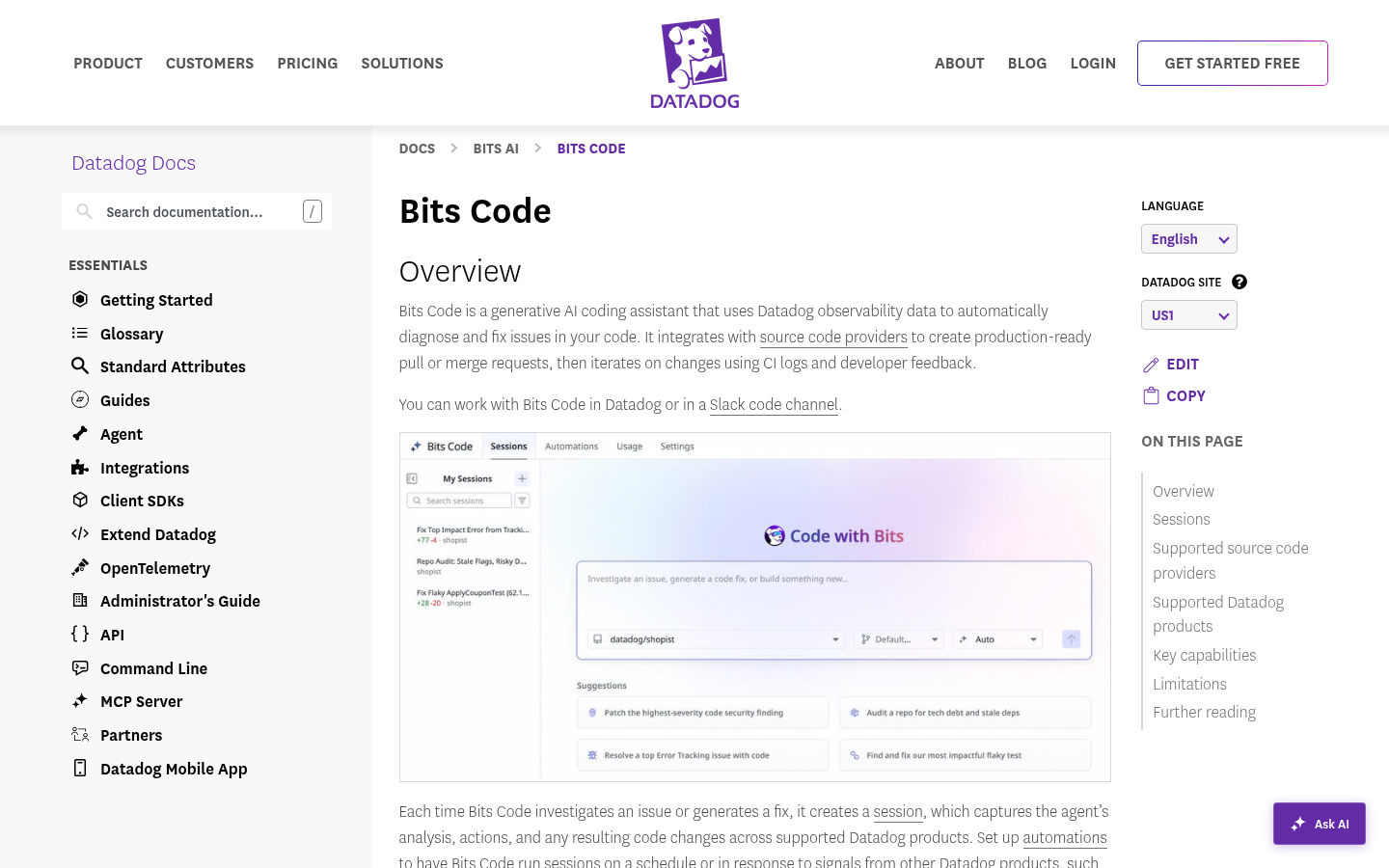
Which repositories can Bits Code open pull requests against?
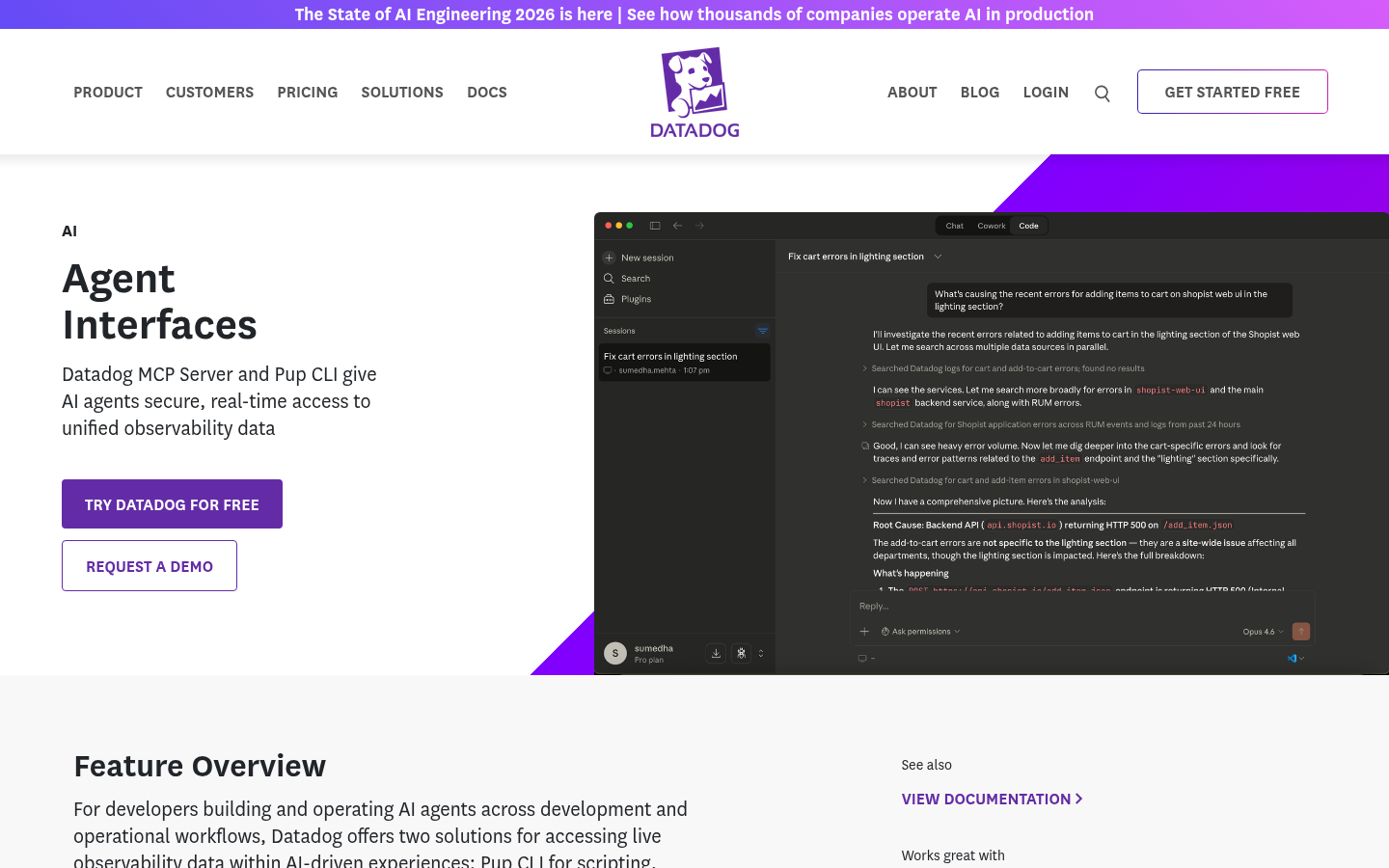
How do I wire an AI coding agent to Datadog telemetry?
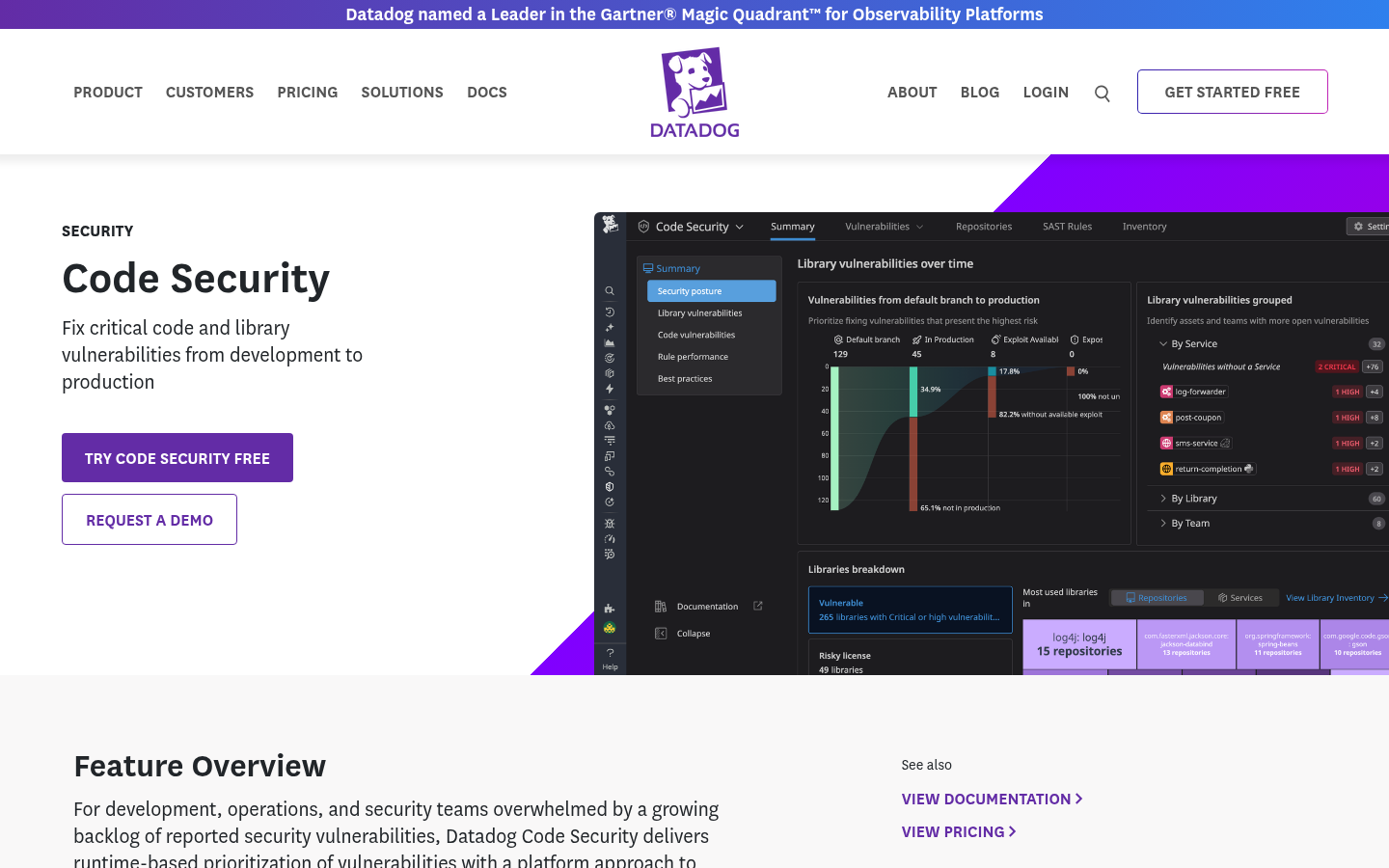
What does Code Security show for a repository with library vulnerabilities?
Pros and cons, in detail
Pros
- Correlation across signals is the real product Metrics, traces, logs, deployment tracking and security signals sit in one view, so an error spike points at the release that caused it.
- Observability data now reaches your agent and your PRs The MCP server serves telemetry to external agents, and Bits Code turns findings from Error Tracking, APM and Code Security into pull or merge requests.
- Setup is fast and the integration catalog is huge A single agent install and 1,000+ integrations explain why reviewers on Gartner and Capterra praise time to first dashboard.
Cons
- Billing units multiply faster than most teams expect Hosts, committers, retained spans, custom metrics and AI credits each have their own meter. TrustRadius reviewers and Trustpilot complaints converge on forecasting pain.
- Bits Code is single-repo and credit-metered The docs state it does not support multi-repository investigations, and every fix draws about 5 credits. Cross-service bugs need a human to stitch repos together.
- Sales and support friction is documented publicly Trustpilot reviewers report unsolicited outreach and slow billing disputes. Capterra reviewers mention slow issue resolution and uneven OpenTelemetry compatibility.
Final verdict
Datadog earns its reputation. If your problem is understanding what production is doing and tying it back to a commit, no other single vendor we looked at covers traces, logs, deploys, security and AI triage as tightly. The new code-facing features move it from a place you look at to a place that opens pull requests, and the MCP server is the most practical piece for teams already working in Claude Code or Codex CLI.
The price of that coverage is a bill with at least five independent meters. Plan for hosts, APM, retained spans, committers and AI credits before you sign, and set up usage alerts on day one. Teams below 10 hosts, or teams that need multi-repo AI fixes today, should compare Grafana Cloud and New Relic before committing.
Recommended for platform teams and mid-size engineering orgs that value one console over the lowest invoice. Not recommended for cost-sensitive startups or anyone who needs self-hosting.
- Observability depth 9.2/10 Best correlation across signals
- Code-facing AI 6.8/10 Useful but single-repo
- Pricing clarity 4.6/10 Five meters, hard to forecast
- Setup speed 8.4/10 Agent install, 1,000+ integrations
- Fit for small teams 5.5/10 No permanent free tier
Common questions
Is Datadog worth it for a small engineering team?
What is Bits Code?
How much does a Bits Code fix cost?
Can I use Datadog with Claude Code?
Why is the Trustpilot rating so low?
Does Datadog support multi-repo AI fixes?
Is Datadog self-hosted or SaaS only?
Update log
- Initial publication: pricing, Bits Code docs, MCP server and review platform ratings checked on 29 October 2026.