Pricing audited November 2026
LaunchDarkly Pricing 2026: What Teams Really Pay a Year
Plans, meters and three cost scenarios, checked against the live pricing page and 980 customer reviews.
Summary
LaunchDarkly pricing starts free, then bills per service connection ($10 a month yearly) and per 1K client-side users ($8.33). We priced three team profiles: $2,700 a year at 20 connections, $16,496 at 60 and $123,260 at 200 with 1M users. This review weighs those numbers against a 4.5/5 G2 score and cheaper alternatives, and tells you which teams should stay on the free plan.
LaunchDarkly pricing is fair at small scale and brutal at large scale: our model puts 60 service connections and 100K client-side users at $16,496 a year, against $3,900 for ConfigCat Smart. Excellent product, 4.5/5 on G2, but the meters punish containers and consumer apps.
- Product depth
- 9/10
- Price predictability
- 5.5/10
- Value at small scale
- 8/10
- Value at large scale
- 5.5/10
- Flag hygiene tooling
- 6.5/10
- Free Developer plan with unlimited seats and unlimited flags
- Instant kill switch and progressive rollouts praised across 980 reviews
- Foundation is self-serve, no sales call needed below enterprise scale
- Service connections count every replica, worker and staging environment
- Code references and mandatory approvals stay locked behind Enterprise
- Client-side MAU billing makes consumer app costs hard to forecast
Free Developer plan, no credit card required
How we audited the pricing
- Plan paid
- No paid plan: public pricing audit of the Developer, Foundation and Enterprise tiers
- Version tested
- launchdarkly.com/pricing as served on 26 November 2026 (Release Autopilot, AgentControl and observability meters included)
- Test period
- 2026-11-26 → 2026-11-26
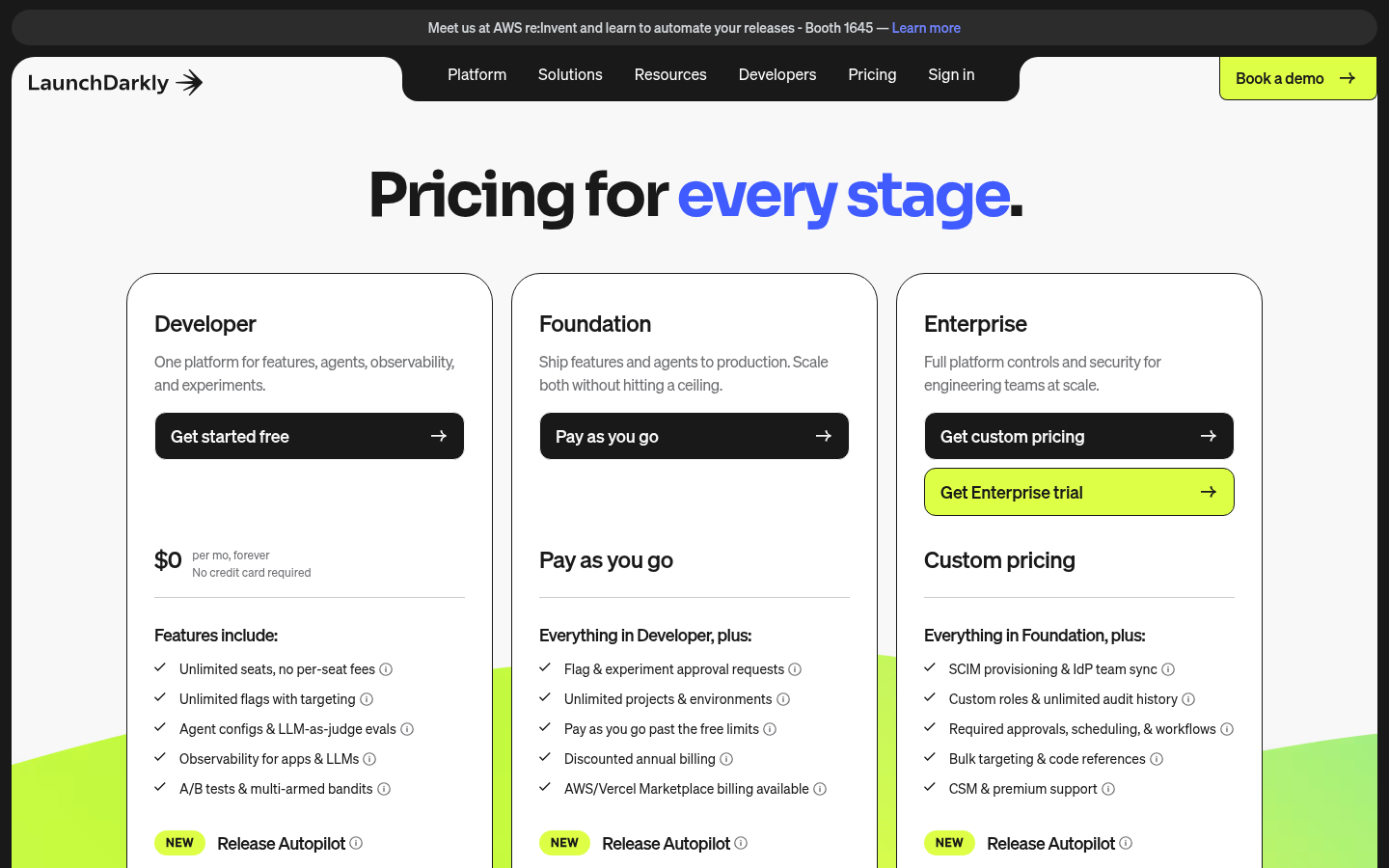
We did not subscribe, so this is not a hands-on usage test and we do not claim one. We read the live pricing page and its feature comparison tables on 26 November 2026, and captured it at 1440 by 900. We then priced three realistic team profiles using the published per-unit rates, billed yearly, and cross-checked the arithmetic against LaunchDarkly's own worked example ($58.33 a month for 10 connections and 2K MAU). Finally we aggregated reviews from G2, Capterra, Trustpilot and Reddit threads, and priced two alternatives from their public pages. Scenarios are our assumptions, not LaunchDarkly quotes.
Should you buy this?
YES if you...
- Teams of 5 to 30 engineers with a handful of services who want flags, rollouts and a kill switch without running anything
- Platform teams that need audit history, SCIM and required approvals and can budget for Enterprise
- Teams shipping LLM features that want agent configs, evals and flags in one tool
NO if you...
- Kubernetes-heavy backends with dozens of replicas per service, where connection counting inflates the bill
- Consumer apps with hundreds of thousands of client-side users and thin margins
- Teams that only need on/off toggles and would be fine with an open-source server
LaunchDarkly plans, as published in November 2026
Three tiers, unlimited seats on all of them. The meters, not the seats, drive the bill.
Developer
For trying it and for small projects
- 5 service connections and 1K client-side MAU free
- Unlimited flags, seats and targeting
- 1 project and 3 environments
- 14 days of trace retention
- 5K AgentControl AI runs, 5K session replays
Foundation
$12 per connection billed monthly
- Client-side MAU at $8.33 per 1K yearly ($10 monthly)
- Unlimited projects and environments
- Optional approval requests with 1 to 5 reviewers
- 30 days of retention
- AgentControl runs at $5 per 1K past the free 5K
Enterprise
Volume discounts sized in a contract
- SCIM, SSO, custom roles, unlimited audit history
- Mandatory approvals, scheduling and workflows
- Code references and bulk targeting
- Silver support, CSM, 99.99% uptime tiers
ROI breakdown: LaunchDarkly's own example: 10 connections and 2K MAU = $58.33 a month billed yearly. We reproduced it: (10 - 5) x $10 + (2 - 1) x $8.33 = $58.33. A 12-person team with 8 services in 3 environments already sits near 24 connections.
Hidden costs & gotchas
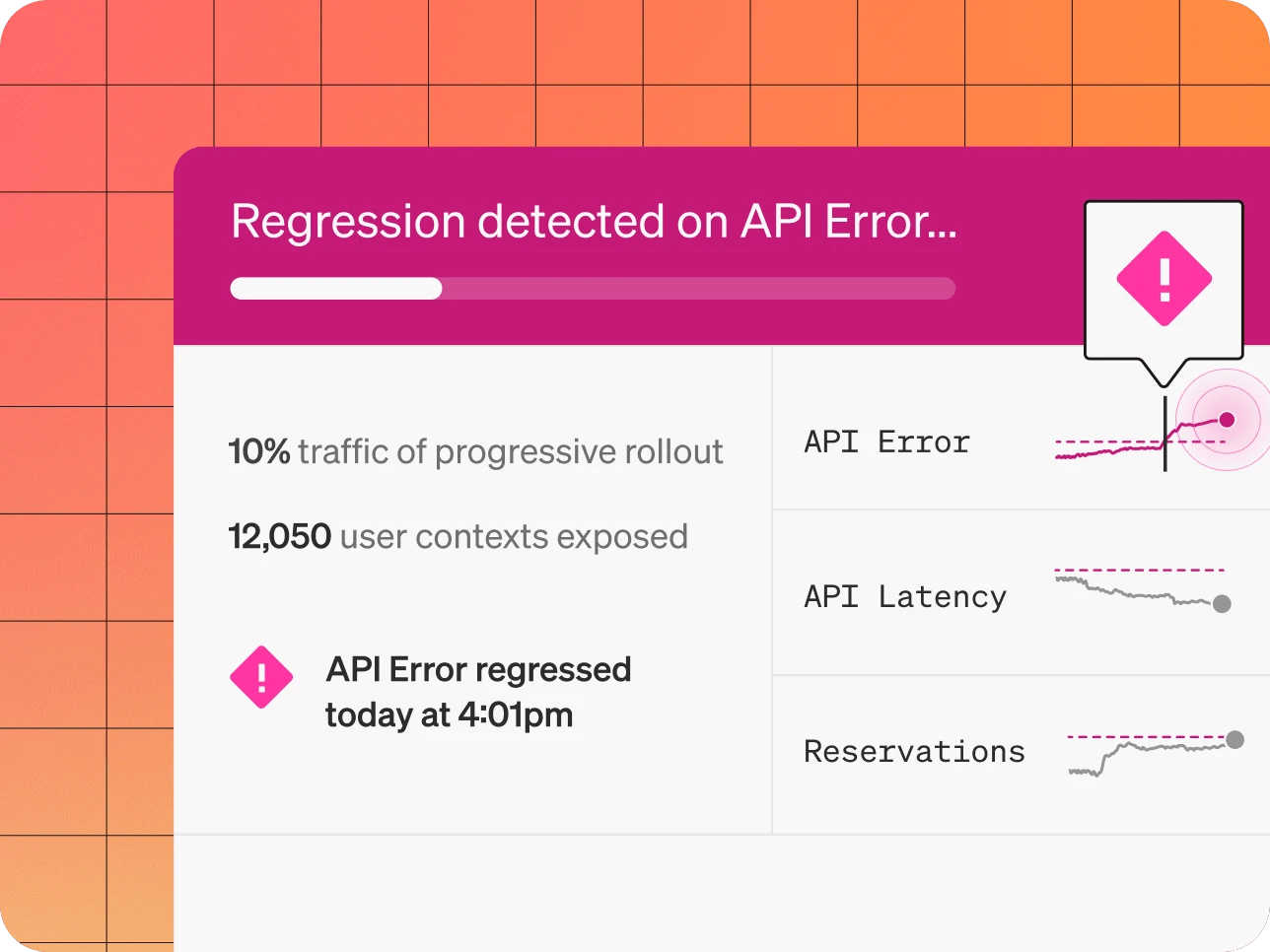
- Release Autopilot is free on Foundation only until 1 February 2027, and the post-promo price is not published
- Every replica, worker and dev or staging environment counts as a service connection
- Annual billing saves 17% but locks the commitment for 12 months
- Enterprise-only features such as code references and required approvals force a sales conversation
What we measured and computed
Public price points, our scenario arithmetic and review data, each with its source.
- Free tier service connections
- 5 connections Developer plan, launchdarkly.com/pricing, 26 Nov 2026
- Price per extra service connection
- $10 /mo billed yearly $12 billed monthly, a 16.7% annual discount
- Price per 1K client-side MAU
- $8.33 /mo billed yearly Roughly $0.0083 per user, 1K MAU free
- Small team, 20 connections and 10K MAU
- $224.97 /mo billed yearly $2,700 a year. Our arithmetic: 15 x $10 + 9 x $8.33
- Container team, 60 connections and 100K MAU
- $1,374.67 /mo billed yearly $16,496 a year. 55 x $10 + 99 x $8.33
- Consumer app, 200 connections and 1M MAU
- $10,271.67 /mo billed yearly $123,260 a year. 195 x $10 + 999 x $8.33, before Enterprise discounts
- G2 average rating
- 4.5 /5 935 reviews, November 2026
- Capterra average rating
- 4.6 /5 45 reviews, last updated 25 Nov 2026
Which plan does a team land on, and what does the public page say it includes?
What does a guarded release look like when a metric regresses?
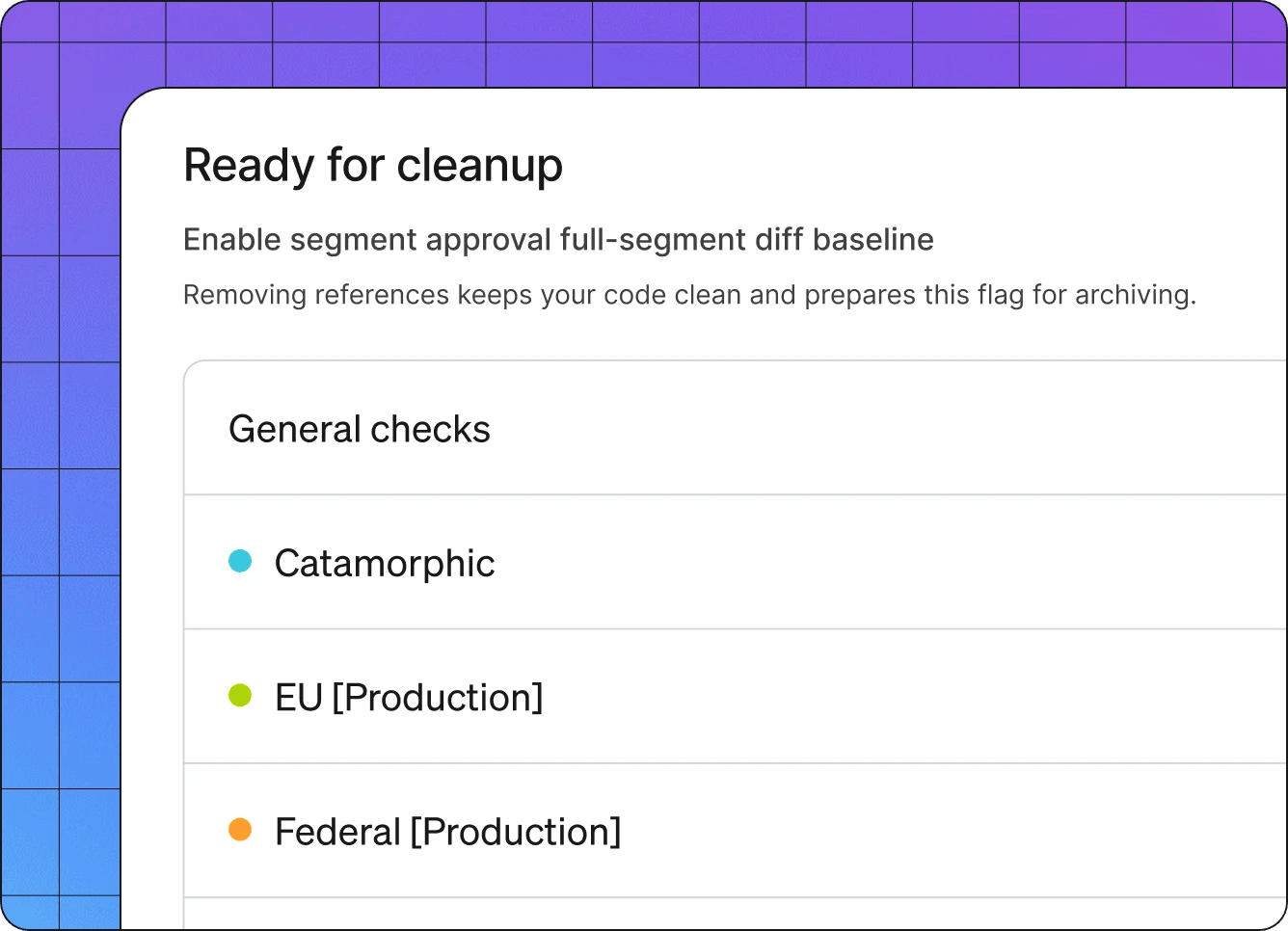
How does the tool help with stale flags, the top complaint in reviews?
Pros and cons
Pros
- Unlimited seats and flags even on the free plan No per-seat fee on any tier, so product, QA and support can all get access. Only usage is metered.
- Kill switch and progressive rollouts are the reason people stay A Capterra reviewer calls disabling a feature in seconds during an incident the single most valuable capability.
- Foundation is genuinely self-serve Pay as you go with no contract, and billing through AWS or Vercel Marketplace if procurement prefers it.
- Free Developer plan includes agent configs and evals AgentControl, online evals and A/B tests are included, which few rivals match at $0.
Cons
- Service connections count every replica and environment The pricing page says each replica, worker and dev or staging environment counts. A pod autoscaler can quietly raise the bill.
- Code references are Enterprise only Seeing where each flag lives in your code is gated, while stale flags are the most repeated complaint in the reviews we read.
- Required approvals and SCIM need a sales contract Foundation has optional approval requests. Making approvals mandatory, audit logging and SSO sit in Enterprise.
- Reviewers say the UI takes too many clicks Two Capterra reviewers in November 2026 mention clicks to apply changes, one works around it with the MCP server.
Final verdict
LaunchDarkly is the most complete feature management product we priced, and the pricing is honest about what it meters. The problem is the meters. Service connections and client-side MAU scale with your architecture and your audience, not with the value you get from a flag, so the bill tracks container counts and traffic.
If you run a few services and under 10K client-side users, you will pay a few hundred dollars a month and get a very good product. That is cheaper than the per-seat alternatives we priced. If you run 60 or more connections, or a consumer app, model your numbers before signing, because the same product reaches $16,496 a year in our container scenario and over $120K in the large one, before Enterprise discounts.
Start on the free Developer plan, count your real service connections including staging, and revisit when Release Autopilot pricing is published after 1 February 2027. Teams already drowning in stale flags should weigh the cleanup tooling against the Enterprise-only code references.
- Product depth 9/10 Flags, experiments, agents, observability
- Price predictability 5.5/10 Meters follow architecture and traffic
- Value at small scale 8/10 $225 a month for 20 connections and 10K MAU
- Value at large scale 5.5/10 $16,496 a year at 60 connections
- Flag hygiene tooling 6.5/10 Cleanup exists, code references gated
LaunchDarkly pricing questions
Is LaunchDarkly free?
How much does LaunchDarkly cost per month?
What counts as a service connection?
Does LaunchDarkly charge per seat?
What does Enterprise add?
Why do reviewers call LaunchDarkly expensive?
What are cheaper alternatives?
Update log
- Initial publication: pricing audit of the Developer, Foundation and Enterprise plans, three cost scenarios and review aggregation.