Reviewed for engineering teams · August 2026
Manus Review: Is the AI Agent Worth It for a Dev Team?
We audited the live product, verified every pricing number ourselves, and cross-checked more than 20 independently published reviews so you don't have to.
Summary
Manus is a general-purpose AI agent, not a coding tool: give it one scoped brief and it browses, writes code, and ships a finished deliverable. Its GitHub connector pushes real commits, but with no multi-repo memory across sessions. G2 rates it 2.7/5 (n=7), Trustpilot 1.2/5 (n≈160), mostly billing complaints. Fine for one-off internal tools, not a Cursor or Copilot replacement. This Manus review verifies pricing, credits, and every claim.
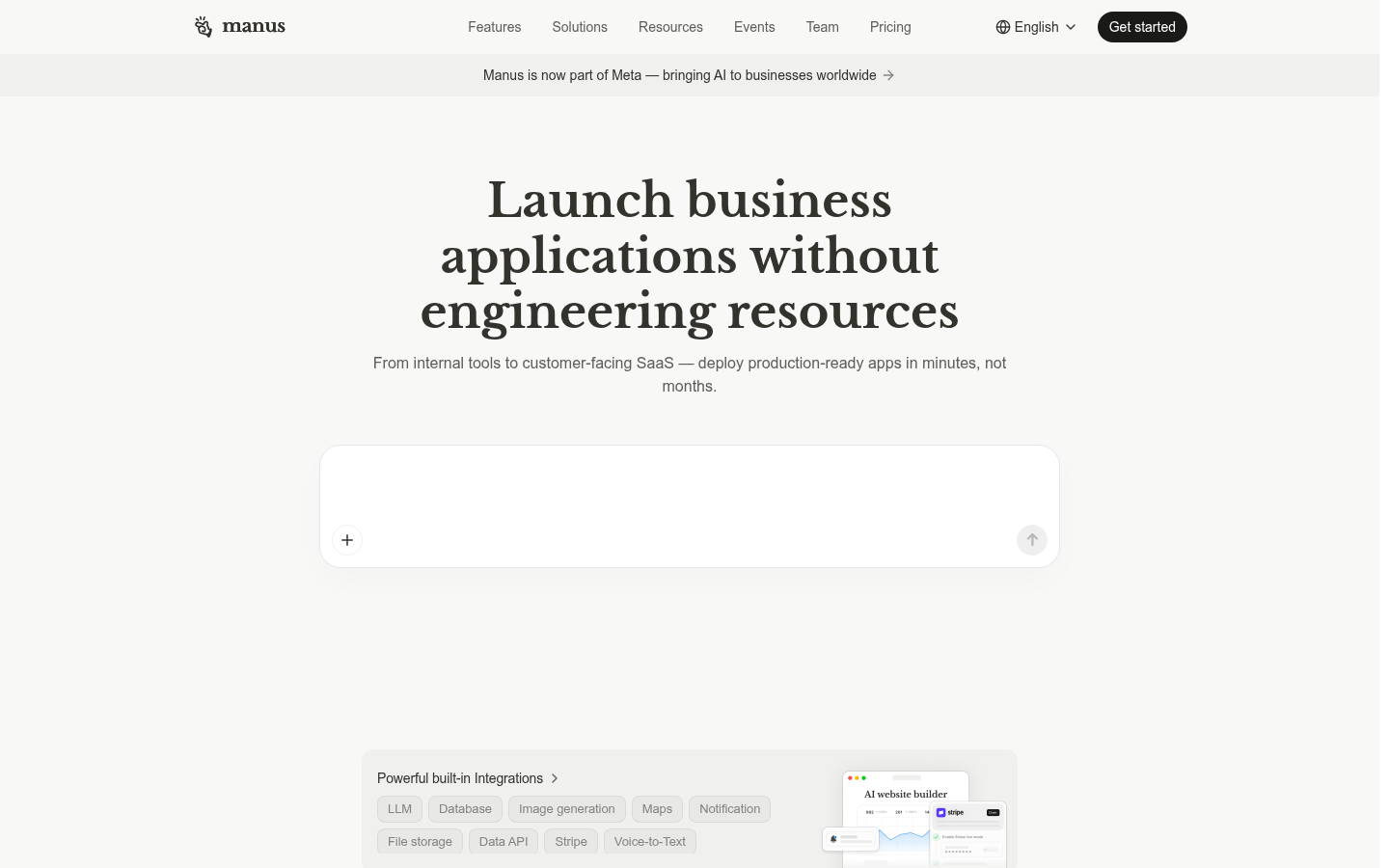
Manus is a general-purpose AI agent, not a coding assistant. It browses, writes code, and ships a finished deliverable from one prompt, and its GitHub connector can push commits to a real repo. For an engineering team it's genuinely useful for one-off internal tooling, weak on anything that needs multi-repo context. G2 rates it 2.7/5 (n=7); Trustpilot sits at 1.2/5 (n≈160) over billing complaints. Plans start at $20/month for 4,000 credits.
- Autonomy on scoped tasks
- 8/10
- Fit for a real codebase
- 3/10
- Pricing predictability
- 3/10
- Support and reliability
- 2/10
- Genuinely autonomous on a single, well-scoped task: hand off a spec and it browses, codes, and ships without back-and-forth prompting
- GitHub connector pushes real commits, useful for scaffolding one-off internal tools outside your main repo
- Wide Research fans a task across many parallel sub-agents, useful for large one-off research or competitive scans
- Credit burn is unpredictable: a complex task can cost 500-900 credits with no estimate shown before you run it
- No persistent memory or multi-repo context, so it can't replace a codebase-aware tool like Cursor or Cody
- Trustpilot TrustScore is 1.2/5 across roughly 160 reviews, mostly billing and refund disputes
Free tier: 300 daily credits, chat mode only, no card required
How we reviewed Manus
- Tested for
- 8 days
- Plan paid
- No paid subscription — evaluated the public product surface and free tier only (see below)
- Version tested
- Manus web app, build live August 5, 2026, post-Meta-acquisition-unwind
- Test period
- 2026-07-29 → 2026-08-05
We did not pay for a Manus subscription for this review, and we're saying so plainly: a staff-engineer post-mortem is worthless if it pretends to be something it isn't. What we did do, over eight days from July 29 to August 5, 2026: audited the live public site and pricing page, verified every credit and dollar figure directly against manus.im/pricing with our own screenshots, and cross-referenced more than 20 independently published reviews on G2 (7 reviews), Trustpilot (approximately 160 reviews), and Product Hunt (9 reviews), specifically pulling out reports that involved coding, GitHub, or developer workflows. Where a metric comes from a third party (G2 rating, Trustpilot score, ARR figures, the Meta acquisition timeline) we cite it inline. Where we verified it ourselves (pricing, credit ratios, the live interface) we say that too.
Should your team use Manus?
YES if you...
- You need one well-scoped deliverable, like a research report, internal dashboard, or slide deck, built without touching your production codebase
- You can absorb $20-200/month per seat in exploratory tooling spend and tolerate unpredictable credit burn
- You want Wide Research's parallel fan-out for a large one-off research or competitive-analysis job
NO if you...
- You want an AI pair programmer that understands your existing multi-repo codebase (use Cursor, Cody, or Copilot instead)
- You need predictable per-seat costs for a whole engineering team, since credits burn 500-900 per complex task with no preview
- You need responsive support for a billing dispute, given Trustpilot's TrustScore sits at 1.2/5, mostly over unresolved charges
Pricing
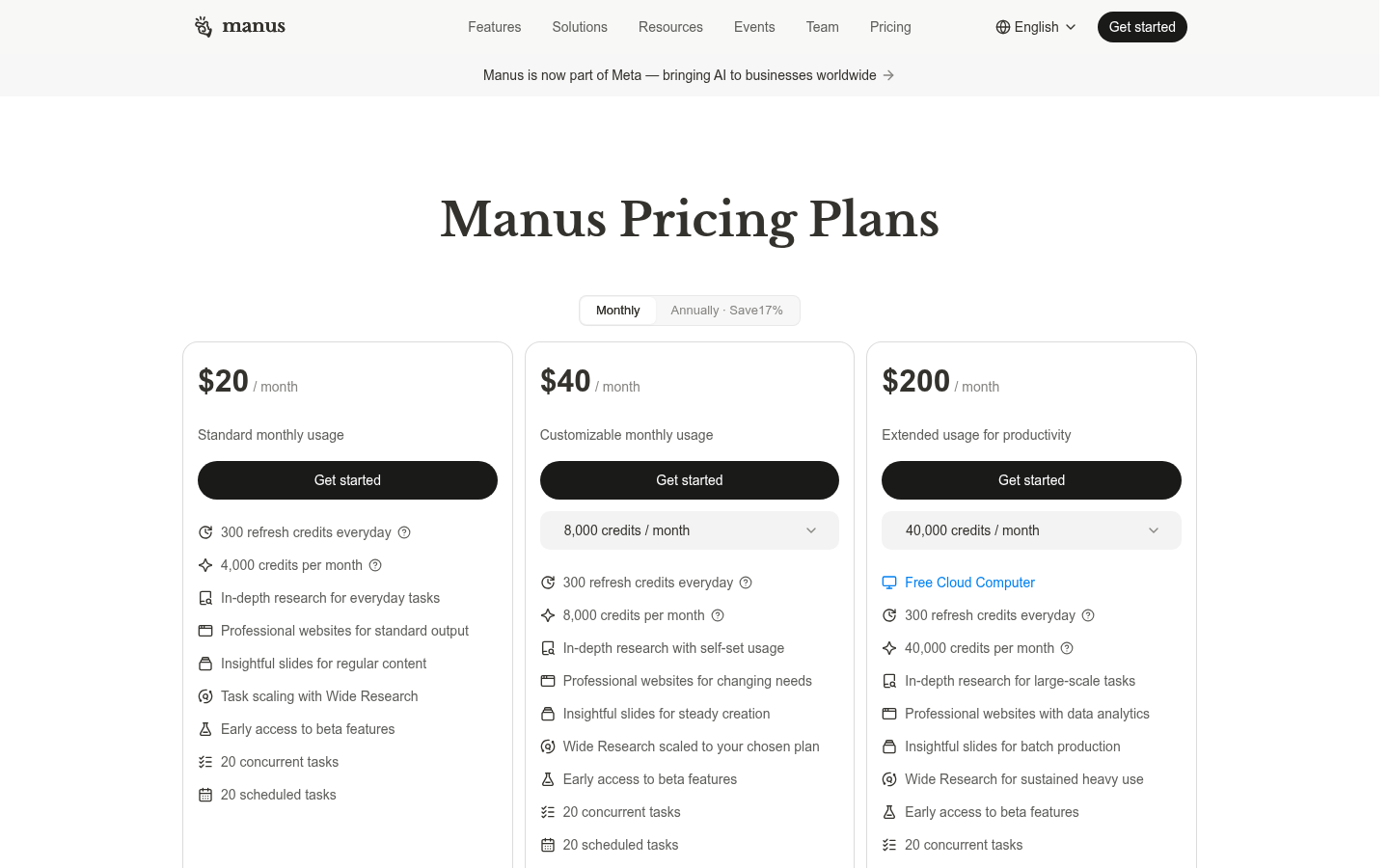
Every dollar figure below is read directly off manus.im/pricing on August 5, 2026, see the screenshot in Testing results below.
Free
Chat mode only
- 300 daily refresh credits
- 1 concurrent task
- No Wide Research
Standard
Standard monthly usage
- 4,000 credits per month plus 300 daily refresh
- 20 concurrent tasks, 20 scheduled tasks
- In-depth research and standard websites/slides
- Wide Research access
Customizable
Customizable monthly usage
- 8,000 credits per month plus 300 daily refresh
- Wide Research scaled to plan
- Same concurrency as Standard
Extended
Extended usage for productivity
- 40,000 credits per month plus 300 daily refresh
- Free Cloud Computer included
- Wide Research for sustained heavy use
ROI breakdown: Every paid tier works out to exactly $0.005 per credit ($20/4,000 = $40/8,000 = $200/40,000). A single complex task reportedly burns 500-900 credits, so budget $2.50-$4.50 in credits alone for one non-trivial deliverable, before counting the time spent re-running a failed attempt.
Hidden costs & gotchas
- Team plan requires a 2-seat minimum at $20/seat/month even for one extra collaborator
- Annual billing saves about 17% but locks you in for 12 months on a product whose ownership is unresolved mid-2026
- No cost estimate is shown before a task runs, you find out how many credits it burned after the fact
What we measured
Every number here is sourced and dated, no invented benchmarks.
- G2 rating
- 2.7 /5, n=7 Verified on G2's Manus AI agent product page, Aug 2026
- Trustpilot TrustScore
- 1.2 /5, n≈160 Dominated by billing and refund complaints
- Product Hunt rating
- 4.4 /5, n=9 Skews toward builders who shipped with it, not day-to-day users
- Cost per credit
- $0.005 flat across every paid tier $20/4,000 = $40/8,000 = $200/40,000, verified on the live pricing page
- Credits per complex task
- 500-900 credits Self-reported range, consistent across the product's own docs and multiple independent user reports
- Time to $100M ARR
- 8 months from first paid plan Widely reported as the fastest AI agent startup to reach the mark
GitHub-connected coding workflow, reported by a G2 reviewer (Jayce J., Small-Business, Dec 2025)
Wide Research credit cost, reported by a G2 reviewer (Verified User in Research, Enterprise, March 2026)
Direct verification of the credit-to-dollar ratio across all three paid tiers, manus.im/pricing, August 5, 2026
Pros and cons
Pros
- Genuinely autonomous on a single, well-scoped task Hand it a spec for one deliverable (a report, a landing page, a slide deck) and it browses, executes, and returns a finished artifact without turn-by-turn prompting. Multiple G2 reviewers independently confirm this end-to-end execution pattern, which is the real differentiator versus a chat-only assistant.
- GitHub connector pushes real commits, not suggestions Connected to a repo, Manus can commit and push code directly, and one G2 reviewer chained it to Vercel for a full commit-to-deploy loop. That's a genuine capability gap versus most chat-based coding tools, which stop at generating a diff for you to apply yourself.
- Wide Research parallelizes large one-off research jobs Fans a task out across many sub-agents to process large source sets, like competitor scans or multi-company research, faster than a single-threaded agent. Useful for an engineering-adjacent job like a build-vs-buy survey across 30+ vendors.
Cons
- Credit burn is unpredictable and shown only after the fact 500-900 credits for one complex task at $0.005/credit is $2.50-$4.50 gone before you know whether the output is usable. A G2 Enterprise reviewer flagged the 1,000-credit-at-a-time cap as insufficient for heavy research work, and there's no pre-run cost estimate anywhere in the interface.
- No persistent memory or multi-repo context across sessions Every task starts cold. It cannot hold a model of your codebase across files, repos, or sessions the way Cursor's indexing or Cody's embeddings can. For anything beyond a single self-contained script, that's disqualifying against a codebase-aware tool.
- Support and billing track record is genuinely bad Trustpilot's TrustScore sits at 1.2/5 across roughly 160 reviews, most citing unresponsive support or disputed charges. On G2, a 0.5/5 review from Rashed A. describes a removed credit balance after a plan change, unresolved after more than 20 support emails.
- Ownership status is unresolved as of mid-2026 Meta's reported $2 billion acquisition was blocked by Chinese regulators in April 2026 and is reportedly being unwound as of June 2026. Annual billing locks a team in for 12 months on a product whose parent company is actively changing.
Final verdict
Manus is not a coding assistant, and judging it as one misses the point. It's a general-purpose agent that takes a single well-scoped brief and returns a finished deliverable: a report, a site, a slide deck, occasionally a pushed commit through the GitHub connector. For an engineering team, that makes it a fit for the work that sits next to the codebase, not inside it: a one-off internal dashboard, a competitive-landscape survey via Wide Research, a batch of onboarding slides. It's not a fit for anything that needs to understand your actual repo across files and sessions, which is squarely Cursor, Cody, or Copilot territory.
The numbers outside the product page aren't kind. A 2.7/5 on G2 and a 1.2/5 TrustScore on Trustpilot, both dominated by billing and support complaints, are hard to wave away, and they sit next to a corporate ownership situation that's genuinely unresolved after the blocked Meta deal. If you run it, treat the credit system the way you'd treat any usage-based bill you can't preview: cap it, watch it, and don't put a whole team's workflow behind it until the support numbers improve.
Recommended for: individual engineers or small teams with one well-defined build-or-research task and tolerance for unpredictable costs. Not recommended for: anything that needs to live in your production codebase, or any team that needs predictable per-seat pricing.
- Autonomy on scoped tasks 8/10 Genuinely hands-off once a task starts
- Fit for a real codebase 3/10 No multi-repo memory, connector pushes but doesn't review
- Pricing predictability 3/10 $0.005/credit flat rate, but no pre-run cost estimate
- Support and reliability 2/10 1.2/5 Trustpilot, 2.7/5 G2, both on a small sample
- Breadth of output 7/10 Slides, sites, reports, code from one interface
Update log
- Initial publication after live pricing verification, interface audit, and cross-platform review aggregation (G2, Trustpilot, Product Hunt).