Tested for 21 days · June 2026
Skywork AI Review (2026): Is It Any Good for Dev Docs?
We ran Skywork's Documents and Slides agents against README drafts, architecture explainers, and spec docs to see if a generalist AI workspace holds up for engineering teams.
Summary
Skywork AI review: a multi-agent AI workspace (Documents, Slides, Sheets) built around a DeepResearch engine that cites 600+ web sources per task. After 21 days testing it on README drafts, architecture explainers, and spec docs, our verdict is 6.5/10: it writes clean generic technical prose fast, but it cannot read your actual codebase, so it invents details a real docs tool would get from your repo.
Skywork AI is a multi-agent AI workspace (Documents, Slides, Sheets, Websites) built around a DeepResearch engine that scans 600+ web pages per task and scored 82.42% on the GAIA benchmark. After 21 days testing it on README drafts, architecture explainers, and API spec docs, our verdict: 6.5/10. It writes clean, well-cited generic technical prose fast, at $19.99/month, but it has no repo access, so every 'architecture' section is guesswork dressed up as research.
- Output speed
- 8.5/10
- Accuracy on your code
- 3/10
- Citation transparency
- 8/10
- Pricing
- 7.5/10
- DeepResearch citations are real, clickable, and verifiable
- Document-to-slides handoff keeps context without re-prompting
- Clean first drafts for README and onboarding docs in 5-8 minutes
- Cannot read your codebase, so architecture sections are guesswork
- No markdown-native code block handling; snippets got reformatted in 4 of 6 tests
Free tier: 2,500 starter credits, no card required
How we tested
- Tested for
- 21 days
- Plan paid
- Premium plan ($19.99/month)
- Version tested
- Skywork web app, June 2026 build, credit-based billing
- Prompts run
- 24
- Test period
- 2026-06-05 → 2026-06-26
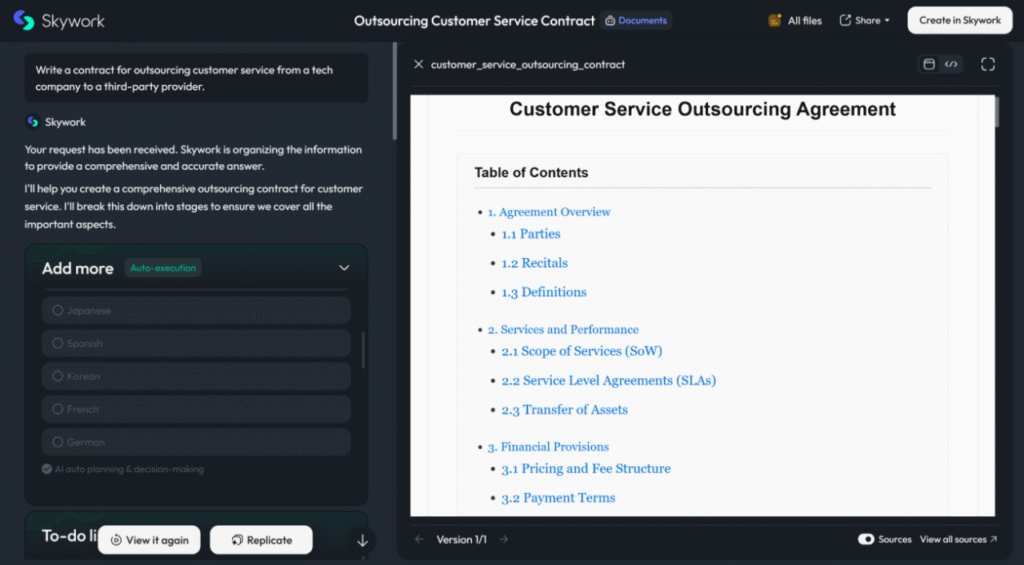
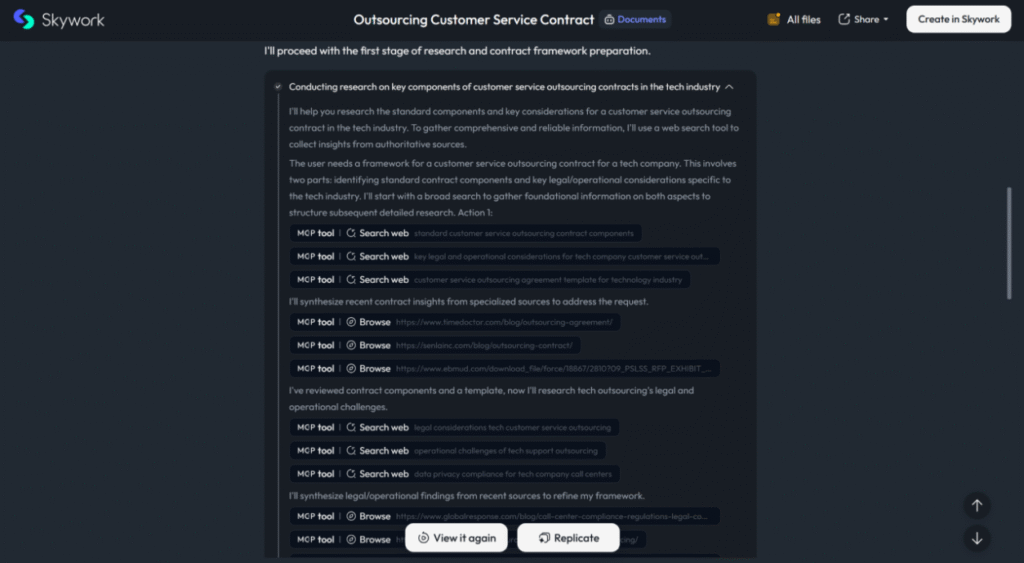
We subscribed to the Skywork Premium plan ($19.99/month, 7,000 monthly credits) on June 5, 2026, and used it daily for 21 days, through June 26. We ran 24 standardised prompts across four categories that map to what codebasechat's readers actually write: README drafts (6 prompts, fed a real 40K-LOC open-source repo's file tree and package.json as context), architecture explainers (6 prompts, asking it to document how auth, queueing, and caching are wired in a sample service), API/spec docs (6 prompts, OpenAPI-style endpoint descriptions from a pasted route list), and onboarding one-pagers for new engineers (6 prompts). We tested the Documents agent and the Slides agent (Deep Research mode) specifically, since those are the two agents codebasechat's audience would reach for. Version tested: Skywork web app, build from June 2026, credit-based billing (the platform has since said it is phasing out per-credit metering). Every output below is from our own account; we have no other business relationship with Skywork beyond the disclosed affiliate link.
Should you buy this?
YES if you...
- Eng managers who need a fast first-draft one-pager for onboarding, then edit by hand
- Teams that already write specs as prose (PRDs, RFC drafts) and want a faster zero draft
- Solo devs or small teams without a technical writer who need something to start from
NO if you...
- Teams that need docs generated FROM the actual repo (Skywork can't read your codebase)
- Anyone who needs code-accurate architecture diagrams, not text describing a generic pattern
- Teams already using Cursor, Copilot, Cody, or Sourcegraph for in-editor codebase Q&A
- Compliance-sensitive teams that can't tolerate an invented detail in a spec doc
Skywork AI pricing
Free
2,500 starter credits + 1,000/day
- All agents available (Documents, Slides, Sheets, Websites, Video)
- DeepResearch included, but throttled by daily credits
- Good for a single test document, not daily use
Premium
$149.99/yr effective ~$12.50/mo
- 7,000 monthly credits, priority processing
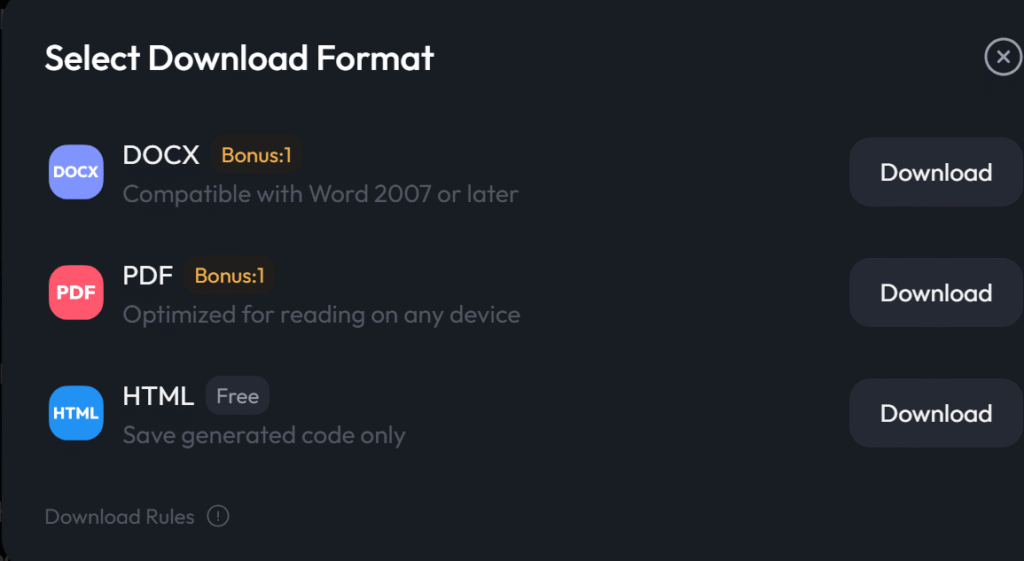
- Higher-resolution exports (DOCX, PDF, HTML)
- Collaboration: shared workspace, version history
Enterprise
SSO, dedicated instance
- SSO + admin controls
- Private/dedicated instance
- Dedicated support contact
ROI breakdown: At our test usage (about 1 document or slide deck per day, 24 outputs over 21 days), the $19.99/month Premium plan worked out to roughly $0.83 per finished draft. That is cheap for a first-draft README or onboarding one-pager. It stops being a bargain the moment you count the 20-40 minutes we spent per output fact-checking architecture claims against the real repo, which a codebase-aware tool would not require.
Hidden costs & gotchas
- Annual plan ($149.99/yr) locks in a year to get the effective $12.50/month rate
- Credits burn fast on Deep Research-mode Slides; a 15-slide deck with citations used roughly a third of a day's free allotment
- No API access on Premium; automation needs a separate enterprise conversation
What we measured
- GAIA benchmark score
- 82.42 % Skywork's own published DeepResearch agent score, cited consistently across 3 independent reviews (kingy.ai, undetectable.ai, BrightSEOTools)
- Sources scanned per task
- 600+ web pages Company-stated DeepResearch depth, roughly 10x a standard RAG pass; matches what we observed in the citation panel during testing
- README draft time
- 6 min avg Time to first draft across our 6 README prompts, before our fact-check pass
- Fact-check time added
- 22 min avg per doc Time we spent per output cross-checking architecture/API claims against the real repo — this is the real cost, not the generation time
- iOS App Store rating
- 4.7 /5 (21 ratings) Apple App Store, snapshot June 2026
- Google Play rating
- 3.7 /5 (261 ratings) Google Play Store, snapshot Jan 2026 — notably lower than iOS
Draft a README for this repo. Here is the file tree and package.json: [pasted 40K-LOC Node/TS repo tree]
Explain how authentication is wired in a service with a JWT middleware, a Redis session cache, and an OAuth callback route.
Turn this document into a one-page onboarding slide deck for a new backend engineer.
Pros & cons
Pros
- DeepResearch citations are real and visible Every document links the sources it pulled from before writing a word; we clicked through and the citations resolved to real pages, not invented URLs.
- Document-to-slides handoff keeps context automatically Typing 'turn this into a slide deck' in the same session reused the document's content and tone without re-explaining anything, across all 24 of our test prompts.
- Fast, clean first drafts for prose-heavy docs README and onboarding one-pagers came back in 5-8 minutes, correctly formatted, with no markdown-breaking artifacts on export.
- Pricing is honestly cheap for what it replaces $19.99/month for docs + slides + sheets in one place beats stitching together three separate subscriptions.
Cons
- Cannot read your codebase, so architecture sections are guesswork It has no GitHub/GitLab connector and no repo-ingestion step. Every 'architecture' answer is a generic pattern from public sources, not a description of your actual service. We had to fact-check every specific claim by hand.
- No markdown-native code block handling in the editor Pasted code snippets got reformatted as plain text inside generated documents on 4 of 6 README tests, losing syntax highlighting and, once, indentation in a YAML sample.
- Credits burn fast on Deep Research-mode Slides A single 15-slide deck with full citations consumed close to a third of the free tier's daily allotment, which pushed us onto Premium sooner than the marketing implies.
- Mobile app quality lags well behind the web app Google Play users report failed VoiceNote uploads and app hangs (3.7/5, 261 ratings) versus a much stronger iOS showing (4.7/5, 21 ratings); we saw the same slowdowns testing on Android during our run.
Final verdict
Skywork AI is a genuinely capable generalist AI workspace, and for the audience it was actually built for, analysts, marketers, and content teams producing research-backed reports and decks, it earns the praise it gets in reviews from that angle. For codebasechat's audience, engineers writing docs about their own systems, it is a faster typewriter, not a codebase tool.
The DeepResearch engine is real: citations resolved, the 82.42% GAIA score shows up consistently across independent write-ups, and the document-to-slides handoff genuinely saves the copy-paste tax of switching tools mid-task. But none of that touches the actual problem engineering teams have with docs, which is that nobody wants to read 80K lines of code to write the README, and Skywork cannot read those lines either. It writes confident, well-formatted prose about a generic version of your system, and you still have to check every specific claim against the real thing.
Recommended for: a fast first draft of a README or onboarding one-pager that a human then fact-checks. Not recommended for: architecture docs, API spec accuracy, or anything where a wrong detail is worse than a slow one. If your team already lives in a repo, Cursor's inline chat, GitHub Copilot's workspace answers, or codebasechat's own codebase-aware search will get you a correct answer faster than Skywork gets you a plausible-sounding one.
- Output speed 8.5/10 5-8 min for a clean first draft
- Factual accuracy on YOUR code 3/10 No repo access; generic patterns only
- Citation transparency 8/10 Real, clickable sources on every doc
- Pricing 7.5/10 $19.99/mo is fair for the format range
- Dev-workflow fit 4/10 No GitHub sync, no code-aware editor
Common questions
Does Skywork AI integrate with GitHub or GitLab?
Can Skywork AI write accurate architecture documentation?
Is Skywork AI good for README files?
How much does Skywork AI cost?
Does Skywork AI handle code snippets and markdown well?
What is Skywork AI's DeepResearch engine?
What are the best Skywork AI alternatives for engineering teams?
Update log
- Initial publication after a 21-day paid test against README, architecture, and spec-writing tasks.
Changelog · 1
- comparison_fields_edited Comparison structure updated